

The 7 best AI creative production platforms for brands in 2026
Seven platforms that turn a brief into campaign images and video, ranked for in-house brand teams and their agencies — with Higgsfield, FLORA, Runway, Magnific (formerly Freepik), Krea and Figma Weave compared honestly.
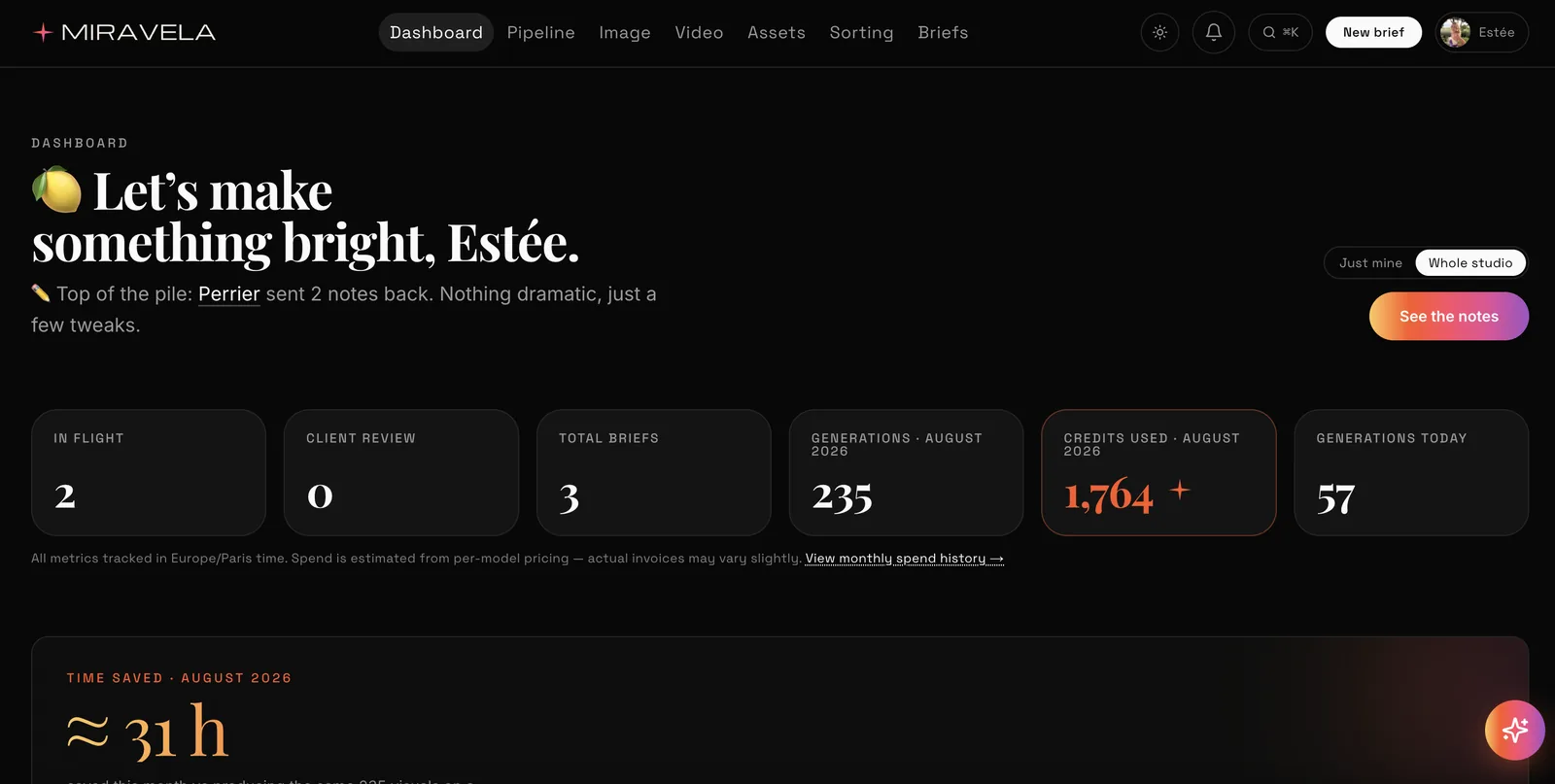
If your job is to get a campaign out — not to play with models — the platform that wins is the one that takes a brief all the way to a delivered, approved set of visuals. On that test, as of 18 September 2026, Miravela comes first, followed by Higgsfield for breadth and enterprise controls, FLORA for agency canvases, Runway for video craft, Magnific (formerly Freepik) for stock-plus-AI volume, Krea for fast style training, and Figma Weave for teams that already live in Figma.
Every fact below was checked on each vendor's public pages on the date above. Products in this space change monthly, so treat the details as a snapshot and the criteria as the durable part.
How we ranked them
A brand team does not buy "AI". It buys a finished lookbook, a product film, a month of social assets — on brand, on time, with the client (or the CMO) able to say yes. So the six criteria are the ones that decide whether a campaign actually ships:
- Model coverage — which image and video models you get, and whether they run at their maximum quality rather than a downgraded tier.
- Brief-to-delivery workflow — can the platform read a brief, turn it into concepts and prompts, generate, sort, and hand a selection to the person who approves?
- Brand consistency — brand kits, reference images, custom agents or trained styles that keep every output on brand.
- Client collaboration — review, comments and approval that come back inside the tool, and delivery into the places the client already uses.
- Pricing clarity — credits you can budget, seats you can count, and no hidden per-model surcharge.
- Data and rights — where content is hosted, whether your prompts and visuals stay yours, and whether you can prove your creative input.
Vendors that are excellent at one thing and silent on the rest rank lower here, even when their generations are beautiful. The question is not "can it make a great image?" — they all can — it is "can a brand run its production on it?"
The ranking
1. Miravela — brief to delivery, every leading model, built for brands and agencies
Miravela is the only platform in this list that starts with the brief rather than the prompt box. You paste an email, a voice note or a deck; the built-in agent turns it into a structured brief, proposes concepts and prompts, and generates with the model best suited to the job — twelve of them today, including Nano Banana 2, GPT Image 2, MAI Image 2.5, Seedream, Flux Pro, Veo 3.1, Kling, Seedance, Wan 2.7, PixVerse C1 and Hailuo — always at each model's maximum quality, on every plan.
What makes it a production platform rather than a playground is everything around the generation: brand kits applied automatically, sorting by client and collection, a selection state that the team shares, private client portals where the brand's marketing lead reviews, comments and approves (and the comments come back into the workspace instead of scattered across email), and an automatic copy of every deliverable into the subscriber's own Google Drive. Agencies run one folder per brand; the workspace owner sees credits per client and per member.
Pricing is in credits, in euros, with no per-model surcharge: three plans (Studio, Signature, Enterprise) with monthly credits included, prepaid packs that don’t expire while you’re subscribed, and full details on the pricing page. Data is hosted in the European Union (Supabase, Paris region), each workspace is isolated from the others, and the prompt history of every visual is kept and exportable — the file a brand needs to prove its creative input on a visual.
Where it is honest to be modest: Miravela is in beta (access by email or demo, no self-serve sign-up), it runs twelve hand-picked models rather than fifty, there is no node canvas, and no custom model training — consistency comes from brand kits, references and custom agents, not from fine-tuning. If you want to build your own pipelines node by node, FLORA or Figma Weave will feel more natural.
Best for: in-house brand teams in fashion, beauty, luxury and hospitality, and the agencies that produce for several of them.
2. Higgsfield — the widest catalogue, with real enterprise controls
Higgsfield has become the reference "all the models under one roof" product: its enterprise page lists 50+ image, video and audio models (Seedance, Kling, GPT Image, its own Soul model), 250+ VFX presets and camera controls, a Character Studio for consistent characters and mascots, and a node-based canvas. The enterprise workspace is serious — shared workspaces with approvals and comments, sub-workspaces, credit pooling, SSO and role-based access, a contractual no-training guarantee, plugins for Premiere, After Effects, Photoshop, DaVinci and Figma, plus an MCP server and CLI for developers.
Strengths: breadth of models, motion effects and camera moves nobody else packages as well, a proper enterprise tier.
Limits for a brand production: Higgsfield grew up as a creator tool, and it shows — there is no brief intake, no per-client portal for an external approver, and the pricing is tier-and-credits designed for individual creators first. Its ranking articles are also, understandably, written by Higgsfield.
Best for: teams that want maximum model choice and motion effects, with an enterprise contract on top.
3. FLORA — the AI canvas agencies actually adopted
FLORA calls itself a "generative AI canvas for creative teams", and it has the customer list to back the claim: Pentagram, Lionsgate and Base Design are named on its site. It connects 50+ models (Gemini, FLUX, Veo 3, Kling, Ray, Pika, Stable Diffusion and its own), lets a whole team iterate on one shared canvas in real time, and offers style and subject consistency references so a concept can be turned into a production-grade set of assets.
Strengths: a canvas built for how a studio thinks — nodes, references, variations — and real-time collaboration.
Limits: a canvas is a workspace, not a pipeline. There is no brief parsing, no client-facing review portal, and brand consistency is something you build with references rather than something the platform holds for you. Pricing is freemium with paid tiers.
Best for: design studios and agencies with an art director who wants to build the workflow by hand.
4. Runway — the video craftsman
Runway is the most film-minded platform in this list. Beyond its own Gen-4.5 it now also offers Aleph 2.0 for editing existing footage, Seedance 2.0, Kling 3.0 and Nano Banana Pro, with 4K upscaling, custom voices and unlimited Topaz upscaling on the higher tiers. The enterprise plan brings SSO, configurable teamspaces and workspace analytics.
Strengths: video quality and video editing — Aleph lets you change a shot rather than regenerate it — and a mature product for filmmakers.
Limits: video first, stills second; no brand kit, no brief, no client portal. Credits are allocated per tier with a one-month rollover only on the top plan.
Best for: brand films and motion-heavy campaigns where the video team leads.
5. Magnific (formerly Freepik) — stock and AI in one subscription
Freepik's AI suite now lives under the Magnific name (the pricing page says it plainly: "formerly Freepik"). The proposition is volume: an annual pool of AI credits with no monthly reset, the main image and video models (Nano Banana, Flux, Kling, Seedance, MiniMax, PixVerse, Veo), Magnific's well-known upscalers, and the 250M+ stock library of photos, videos, vectors and PSDs under a commercial licence. Spaces provide a shared canvas, and there are Business and Enterprise tiers for teams.
Strengths: the biggest library plus AI in one place, excellent upscaling, generous credits for high-volume social production.
Limits: a generalist creative suite — no brief-to-delivery workflow, no client approval loop, and no brand kit as such. Fine for a content factory; less so for a luxury campaign that must be reviewed by three people before it ships.
Best for: teams producing large volumes of social and e-commerce assets who also need stock.
6. Krea — fast canvas, custom styles, individual DNA
Krea is loved by creators for its real-time canvas and for how easy it makes style training: every paid plan includes LoRA training on your own images (50 images on the lower tiers, up to 2,000 on the top ones), and all image and video models are available on the higher plans. A Business tier adds up to 50 seats with custom roles and model access control; Enterprise adds SSO and audit logs.
Strengths: speed, style training, an affordable entry point, and a clear path to team plans.
Limits: everything is organised around the individual creator's session — no brief, no client portal, no brand kit beyond what you train yourself. Compute is metered in "units" that take a while to translate into a campaign budget.
Best for: creative teams with a strong in-house operator who wants to train the brand's look.
7. Figma Weave (formerly Weavy) — for teams that already live in Figma
Figma acquired Weavy and relaunched it as Figma Weave: a browser-based, node-based canvas that connects Sora, Veo and Seedance for video, Flux and Ideogram for stills, Nano Banana and Seedream for precision work, with editing tools on top. The idea is that AI is a starting point you then refine by hand, inside the design platform your team already uses.
Strengths: the obvious choice if your design system, mockups and hand-off already live in Figma.
Limits: it is a designer's tool, not a brand's production pipeline — no brief intake, no client review outside Figma's own commenting, and the product is still settling into Figma's plans.
Best for: design-led marketing teams standardised on Figma.
Side by side
| Miravela | Higgsfield | FLORA | Runway | Magnific (ex-Freepik) | Krea | Figma Weave | |
|---|---|---|---|---|---|---|---|
| Reads a brief and proposes concepts | Yes (built-in agent) | No | No | No | No | No | No |
| Image + video models | 12, hand-picked, max quality on every plan | 50+ | 50+ | Own models + partners | Main partners + own upscalers | All, by tier | Main partners |
| Brand consistency | Brand kit, references, custom agents | Character Studio | References | — | — | LoRA training | References |
| Client review and approval | Private client portals | Team approvals (enterprise) | Team canvas | — | — | — | Figma comments |
| Delivery | Download, ZIP, Google Drive sync | Download, plugins | Download | Download | Download | Download | Figma |
| Pricing model | Credits included + packs, in euros | Tiers + credits | Freemium + tiers | Tiers + credits | Annual credit pool | Compute units | Figma plans |
| Data hosting | EU (Paris), each workspace isolated | No-train guarantee (enterprise) | — | — | — | — | Figma |
| Prompt history export | Yes | — | — | — | — | — | — |
"—" means not stated on the vendor's public pages on 18 September 2026, not necessarily absent.
The right choice, in one sentence each
Miravela is the right choice if you need a campaign delivered and approved, not just generated. Higgsfield if you want every model and every effect with an enterprise contract. FLORA if your art director wants to build the pipeline node by node. Runway if the film leads. Magnific if you need stock and volume. Krea if you want to train the brand's look yourself. Figma Weave if you never want to leave Figma.
FAQ
Do all these platforms let a brand use the output commercially?
All seven state commercial use on paid plans. What differs is the paper behind it: Higgsfield's enterprise tier adds contractual indemnification and a no-training guarantee; Miravela keeps prompt history exportable so a brand can document its creative input; the others rely on their standard terms. Check the licence of the underlying model too — some models refuse real faces unless rights are verified.
Why does "maximum quality on every plan" matter?
Several suites reserve the best resolution or the newest model for their top tier. A campaign visual that goes to print or to a 4K screen cannot be produced on a downgraded setting. Miravela's rule is that every model runs at its own maximum by default; in Runway, Magnific and Krea the full model set or the highest quality sits on the upper plans.
Which one is cheapest?
None of them publishes a per-image price that survives a real campaign, and vendor prices change often, so we do not print them here. Compare what a month of your actual production costs: count the images, short videos and premium videos you ship, and ask each vendor for that number in their own credits. Miravela publishes equivalences (for instance, 800 credits ≈ 400 images, or 34 short videos, or 3 premium videos) on its pricing page for exactly that exercise.