

Miravela vs Flora: AI image and video for agencies
Flora is an infinite canvas for exploring ideas with 50+ models. Miravela is a brief-to-delivery pipeline with client approval. Which fits depends on your bottleneck.
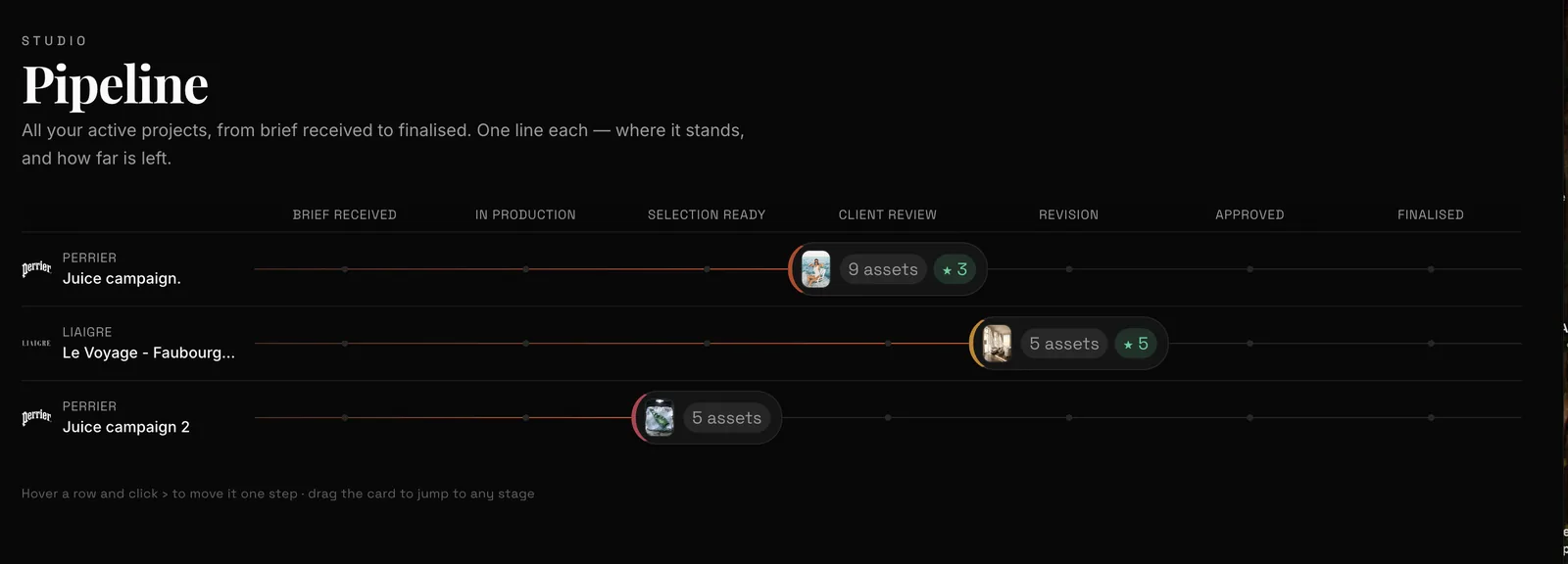
Flora and Miravela both put many AI image and video models under one subscription, but they organise the work differently. Flora is a collaborative node-based canvas where a team explores, branches and chains models, billed per seat against a shared dollar budget. Miravela is a production pipeline that runs from the brief to client approval and Drive delivery, billed in euro credits. Choose Flora if open-ended exploration and custom workflows are your bottleneck. Choose Miravela if briefs, client review and delivery are.
What each tool is
FLORA presents itself as an AI-powered canvas for designers, brand teams and agencies, with 50+ models in one workspace. Its enterprise page cites 170+ models across text, image, video and audio, so the model count depends on which Flora page you read. Flora does not build its own models; it offers an infinite canvas that integrates existing ones. At launch it focused on visual design agencies.
Miravela is an AI creative production platform for brand teams and agencies, built in Paris and in beta since September 2026. It starts with the brief: you paste an email, a voice note or a deck, and the built-in agent turns it into a structured brief, proposes concepts and writes the prompts. It then picks a model for each job from 12 hand-picked image and video models, including Nano Banana 2, GPT Image 2, Flux Pro, Veo 3.1, Kling and Seedance. It runs them at the model's maximum quality on every plan. Miravela was built by the team behind Mira Studio, a Paris creative studio, for its own production work.
Side-by-side comparison
| Flora | Miravela | |
|---|---|---|
| Core idea | A collaborative visual canvas for images, video and audio with many models, reusable techniques and an assistant called FAUNA (source) | Brief-to-delivery pipeline: brief parsing, agent, generation, selection, client approval, Drive delivery |
| Models | 50+ on the homepage (source); 170+ on the enterprise page | 12 hand-picked image and video models, chosen per job |
| Pricing model | Per seat, with each seat's price doubling as a shared dollar usage budget; Free, Starter, Pro and Max tiers plus custom Enterprise (source) | Credits in euros, no per-model surcharge: Studio €199/month, Signature €490/month, Enterprise €1,790/month, excl. VAT (pricing) |
| Reusable workflows | Winning workflows saved as Techniques, run on-canvas, as an app, or via API or MCP (source) | Brand kits applied automatically; custom agents from the Signature plan |
| Client review | Canvas can be shared for collaborative work with clients (source) | Private client portals; comments and approvals return inside the platform |
| Data and security | SOC 2 certification stated; what you make never trains a model (source) | Data hosted in the EU (Paris); workspaces isolated; no training on client content; exportable prompt history |
| Maturity | Public launch in February 2025 (source) | In beta since September 2026 |
How Flora's pricing works
Flora's usage is metered in dollars at published model rates. Any generation from a model counts as usage, but FAUNA messages never count against your budget. Usage History shows the exact dollar cost per generation, per project and per member, which is useful for client billing. Paid tiers start at $18 per seat per month, and annual billing lowers each self-serve tier by 20%. Flora lists these prices in US dollars. See Flora's pricing docs for the current terms.
The catch is video. A Wireflow buyer's guide (written by a Flora competitor, so confirm prices yourself) notes that image work rarely strains a Flora budget, while video work decides which plan you need. There is no one-off top-up; once the monthly budget is used, the workspace upgrades or turns on on-demand spending. Budget by workload, not by headcount.
Miravela's model is different. You buy monthly credits in euros with no per-model surcharge, and prepaid packs do not expire while the subscription runs. Agencies set credit caps per member and one folder per brand. The trade-off is that you pay for credits rather than getting Flora's pass-through of published model rates.
What the generation data shows
These are Miravela platform data from its own database over the last 90 days, aggregated, with no client named. Of 8,544 generations started, 8,079 completed. 7,307 were images and 1,237 were videos.
Speed differs a lot by model. GPT Image 2, the most-used model, ran 3,074 generations with a 95.9% completion rate and a median time of 95 seconds. Nano Banana 2 had a median of 26 seconds, but a lower completion rate of 89.5%. Seedance 2.0 video had a median of 312 seconds and an 88.6% completion rate.
For an agency, this means stills come back in seconds to a couple of minutes, so you can iterate live with a client. Video takes minutes per attempt, and roughly one in nine video attempts did not complete. Plan video rounds around that, whichever tool you use. The same logic applies to Flora's metered video, where retries cost real budget.

Client approval and delivery
This is where the two products differ most. Flora is strongest during exploration. An independent review calls it strongest during visual ideation, reference gathering, model comparison and campaign-direction development (Media.io review). Flora also connects with your cloud storage, according to its enterprise page.
Miravela is built around what happens after the visuals exist. You sort work by client and collection, build a shared selection, and send it through a private portal. The marketing lead or client reviews, comments and approves, and the comments come back inside the platform rather than in email threads. Every deliverable is copied automatically to the subscriber's own Google Drive. The prompt history of each visual is kept and exportable, which is the document a brand needs to show its creative input.

Where Flora is the better choice
- You want a node-based canvas with branching, comparison and custom workflows, and your team is comfortable wiring them.
- You need API or MCP access. Paid Flora plans include API and MCP access.
- You want the widest model catalogue, with Flora stating 50+ or 170+ models against Miravela's 12.
- You need a vendor that is past beta and has stated SOC 2 compliance.
- Your clients review inside your own tools, and you only need the canvas for ideation.
Where Miravela fits
- Your work arrives as emails, voice notes and decks, and you want it turned into a brief and prompts.
- You produce for luxury, fashion, beauty or hospitality brands and want the brand kit applied automatically.
- You run many client accounts and want folders per brand, roles and credit caps.
- Clients must approve inside a private portal, with delivery to your own Google Drive.
- You want euro billing, EU data hosting (Paris) and exportable prompt history. The models themselves run at their providers (Google, OpenAI, ByteDance, Kuaishou and others), not in Europe.
How to choose
- Name your bottleneck: exploring ideas, or moving approved work to delivery.
- Count your video share. Metered video drives Flora's cost; on Miravela it draws on your credits.
- Decide who reviews. Internal creatives on a canvas point to Flora; external clients in a portal point to Miravela.
- Check currency and billing. Per-seat USD with a shared pool, or euro credits with member caps.
- Check data requirements. Ask both vendors where data is hosted and how it is isolated.
- Weigh maturity. Miravela is in beta; Flora has been public since 2025.
- Run one real brief through each tool before you commit.
Miravela's own comparison pages and agency page list details. Many teams may use both: a canvas to explore, a pipeline to deliver.

Questions
- Is Flora or Miravela better for agencies?
- It depends on the bottleneck. Flora suits agencies that want an open node-based canvas, 50+ models and API access. Miravela suits agencies that need a brief-to-delivery pipeline with private client portals, per-brand folders, member credit caps and Google Drive delivery.
- How much do Flora and Miravela cost?
- Flora charges per seat, with paid tiers listed at $18, $50 and $200 per seat per month and a shared usage budget in dollars. Miravela uses euro credits: Studio €199/month, Signature €490/month and Enterprise €1,790/month, excluding VAT, with no per-model surcharge.
- Does Miravela train models on my content, and where is the data hosted?
- Miravela never trains models on client content. Data is hosted in the European Union (Paris) and each workspace is isolated. The models run at their providers, such as Google, OpenAI and ByteDance, not in Europe.
Sources
- FLORA — Generative AI Canvas for Creative Teams
- AI for Enterprise Creative & Brand Teams
- How Pricing Works
- FLORA: Features, Pricing & Alternatives (2026)
- FLORA AI Pricing Guide 2026
- FLORA AI Review: Is It Worth It for Image & Video Generation?
- Flora is building an AI-powered 'infinite canvas' for creative professionals
- Flora AI Pricing in 2026
- Flora AI Review 2026: Creative Canvas, Models & Credits
- FLORA AI review