

Compare
Miravela or Figma Weave (formerly Weavy): which one for a brand or an agency?
Figma Weave, the name of Weavy since it joined Figma, is a node-based canvas for power users: models from a dozen providers plus fine editing nodes (inpaint, relight, upscale), turned into reusable workflows. Miravela is the opposite approach: no canvas to build, the agent works from the brief, twelve hand-picked models run at maximum quality with the brand kit applied, and the client approves in a private portal. Choose Figma Weave to design your own pipelines; choose Miravela to deliver a campaign without building one.
What Figma Weave does well
As of 8 November 2026, weavy.ai redirects to weave.figma.com. It describes AI models and editing tools “in one node-based platform”: models from Google, OpenAI, ByteDance, Kling, Black Forest Labs, Runway, Luma, Wan, Recraft and others, editing nodes such as inpaint, relight and upscale, and workflows that can be published as a simplified app. Its pricing page states that your images and prompts are not used to train the platform, on every plan, and it runs tools through the Figma MCP server.
For a design team that wants precise, repeatable control of every step, and already works in Figma, that canvas is the strongest of its kind.
What Miravela does that Figma Weave does not
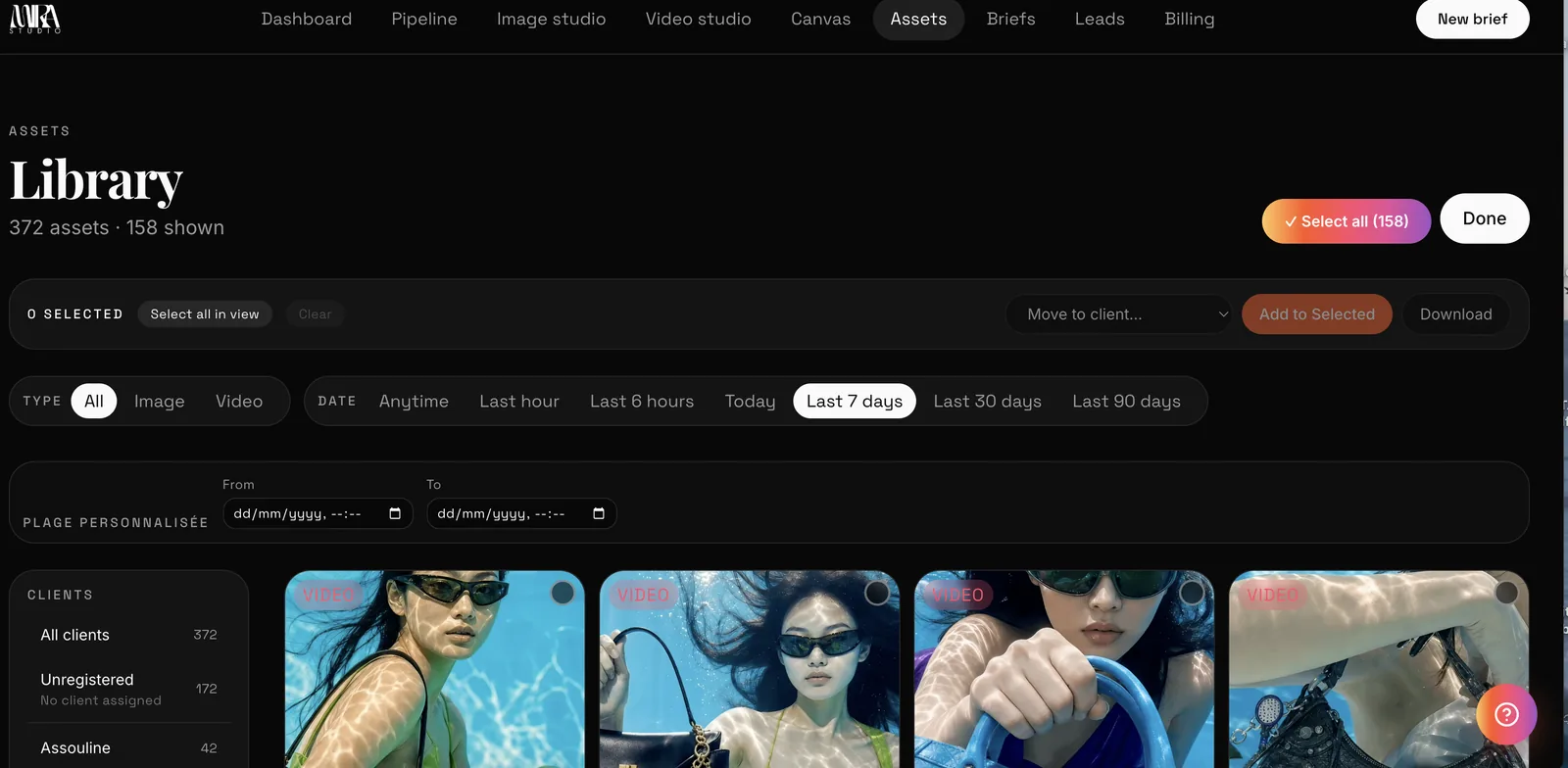
Miravela starts before the prompt: you paste a brief and the agent turns it into concepts and prompts, after naming what must stay identical across the series (product, face, logo). It ends after the generation: a shared selection, a private portal per brand where the client comments and approves from a private link, and delivery into the subscriber’s own Google Drive. The brand kit is applied to every generation, every model runs at its maximum quality on every plan, credits are in euros with no per-model surcharge, data is hosted in the European Union, and the prompt history of every visual is exportable.
Where Miravela is honestly behind
Miravela is a curated platform, not a toolbox. It runs twelve hand-picked image and video models rather than forty or fifty, has no node canvas, no plugins for Adobe or Figma, and no custom model or character training: consistency comes from brand kits, references and custom agents. If your team wants to build and fine-tune its own visual pipelines, Figma Weave is the better fit today.
| Miravela | Figma Weave (formerly Weavy) | |
|---|---|---|
| Starts from a brief (parsing, concepts, prompts) | Yes, built-in agent | — |
| Image and video models | 12, hand-picked, maximum quality on every plan | Models from a dozen providers; count not stated |
| Node canvas | No | Yes, the core of the product |
| Brand consistency | Brand kit applied automatically; references; custom agents (Signature) | Reusable workflows and design systems |
| Client review and approval | Private portal per brand; comments come back inside the platform | — |
| Delivery | Download, ZIP, Google Drive sync | Download; workspace file sharing (team plan) |
| Pricing model | Credits in euros, same price whatever the model; packs that don’t expire while subscribed | Free trial; tiers with credits and per-model costs |
| Data | EU hosting (Paris); no training on client content | No training on your images or prompts; SOC 2; region not stated |
| Developer access | MCP connector for Claude | API (enterprise); Figma MCP server |
Questions people ask
- Is Figma Weave the same product as Weavy?
- Yes. As of 8 November 2026, weavy.ai redirects to weave.figma.com, and Figma announced that Weavy joins its platform as Figma Weave.
- Do we need to build workflows on Miravela?
- No. Miravela has no canvas to build: the agent reads the brief, chooses the model for each shot and prepares the series. You review, select and send for approval.
- Can we use both?
- Yes. A design team can build a precise pipeline on Figma Weave for one recurring task and run client campaigns, approval and delivery on Miravela.