

Which AI video model for which job: Veo 3.1 vs Kling vs Seedance
Which AI video model fits which shot? A practical guide to choosing between Kling, Veo 3.1, Seedance, Hailuo and PixVerse C1 for brand films.
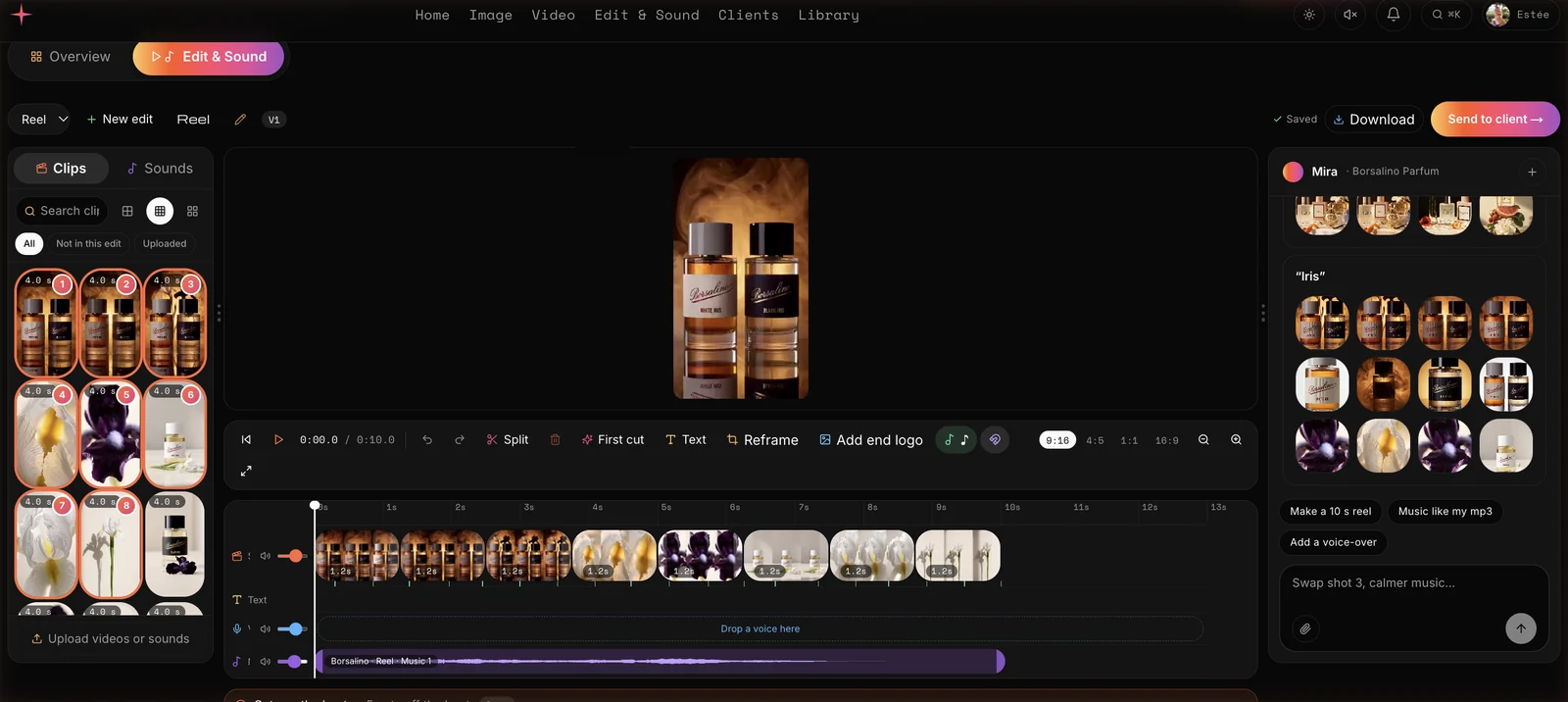
Pick the model by what the shot has to do. Use Kling when bodies and fabric must move, Veo 3.1 when the shot needs realism and native sound, and Seedance when the movement is choreography or rhythm. For faces, look at Hailuo and PixVerse C1. No single model wins every shot of a brand film, so the useful skill is matching model to job.
The map: one job, one model
Here is the short version, using the roles Miravela gives each model on its models page.
| Job in the brief | First model to try | Why |
|---|---|---|
| Runway walk, fabric in motion, sport | Kling | Built for high movement |
| Brand film with ambiance or dialogue | Veo 3.1 | Realistic video with native sound |
| Dance, gesture, rhythm-cut sequence | Seedance | Fluid choreography |
| Close-up emotion, beauty shot | Hailuo | Expressive faces, subtle acting |
| A character who has to act | PixVerse C1 | Emotion and performance that feels directed |
| Establishing shot, set, environment | Wan 2.7 | World building |
| Punchy social clip | Grok Imagine 1.5 | Fast, stylized, made to stop the scroll |
Treat the first column as a starting point, not a verdict. Models ship new versions often, and the one that is best today may not be best next quarter. Before you lock a spec (duration, resolution, audio, aspect ratio), check the model maker's own page. We do not quote those numbers here because they change.
Movement: Kling versus Seedance
Both handle motion well. They handle different kinds of motion.
Kling is the one to try when the subject travels through space. A model walking a runway, a coat swinging as she turns, a runner at full stride, a car cornering. The test is whether weight and cloth behave. If the hem lags a beat behind the hip, the shot reads as real.
Seedance is the one to try when the movement is the point. A dancer, a hand gesture that repeats, a sequence cut to a beat. The test is rhythm: does the body land on the count, and does the motion stay fluid from one phrase to the next?
A practical rule: if you can describe the shot as "someone moves through the frame", start with Kling. If you describe it as "someone performs", start with Seedance.
Our guide on 15-second luxury video for DOOH screens notes that Kling 3.0 and Seedance 2.0 generate up to 15 seconds in one pass. It also says luxury-grade output still needs careful prompting, a spec check and human review. Longer single takes mean fewer cuts to hide problems, so review each one closely.
Realism, sound and faces
Veo 3.1 is the model for shots that need to feel photographed and, above all, to sound right. Native sound is its distinguishing trait: room tone, ambiance, and dialogue when the script calls for it. For a brand film where a hotel lobby should hum, or a fragrance spot needs a footstep on marble, you get picture and sound from one generation instead of a separate sound pass.
Native audio does not remove the need for sound design on a final cut. It gives you a working track that makes selection easier, because a client reacts differently to a silent clip than to one with atmosphere.
Faces are where models split again.
- Hailuo is described on Miravela as expressive in close-up: beauty shots, a held glance, subtle acting.
- PixVerse C1 is described as current video state of the art in blind votes, with emotion and character performance that feels directed.
For a skincare close-up, try Hailuo first. For a short scene where a character reacts, try PixVerse C1 first. Then compare against Veo 3.1 if the shot also needs sound.
One caution for product-led brands. Faces and movement are the easy part to judge. Packaging, labels and logos are the hard part. If a bottle appears in the shot, start from an approved still of the real product, limit the movement, and check the label at full size. Our guides on AI perfume ads that keep the bottle accurate and on the best AI for a new perfume video ad cover this in detail.
Why a platform should pick the model for the job
The honest map has a consequence. If Kling is best for one shot and Veo 3.1 for the next, a team that subscribes to one model will use it for everything and accept weaker results on half the shots. A team that subscribes to four separate tools will juggle accounts, prices and file formats.
Here is a test you can run on any platform in under an hour.
- Write one brief with three shots. For example: a walking shot, a quiet interior with sound, and a close-up of a face.
- Run each shot on at least two models. Keep the prompt and reference image identical.
- Judge on one criterion per shot. Movement for the walk, sound and realism for the interior, expression for the face.
- Check the product at full size. Cap, label, stitching, clasp.
- Count the cost per approved clip, not per generation. A cheap generation that fails three times costs more than a good one that lands first.
That fifth step is why pricing structure matters. Some platforms attach a separate price to each model and the team starts avoiding the "expensive" one even when it is right. Miravela uses credits and runs every model at its maximum quality on every plan, so the choice is made on the shot, not on the invoice.
How it works on Miravela
Miravela Pro is built so the model choice is part of the workflow, not a decision the team has to research each time. Here is a real run for a fashion house.
- Brief. A team member pastes the client email, or sends a voice note or document. Mira turns it into a structured brief: deliverables, formats, deadlines.
- Agent. Mira proposes concepts and gets prompts ready for the Image and Video studios. For the walk, she points to Kling. For the lobby scene with ambiance, Veo 3.1. For the beauty close-up, Hailuo.
- Generation. The brand kit is applied automatically. Mira always shows the cost in credits first and runs the generation only on a click. Nothing spends credits by surprise.
- Selection. The team compares clips from different models side by side in the Library, searchable by what is in the visuals. Reframe turns an approved image into every format, and Upscale handles final quality on video.
- Client portal. Mira prepares a private review link. The client sees only the selection shared with them, never prompts, credits or other clients. They comment on each visual and approve.
- Delivery. Comments come back inside the platform. Approved files download directly, as a ZIP, or copy automatically to the team's Google Drive.
Teams that already work in Claude can use the Miravela MCP connector to list clients and models, launch generations with brand kits applied, and check results, within their own role and credit limit.
On cost: Studio is €199 a month excl. VAT with 2,400 generation credits at the launch offer, and credit packs never expire. Full details are on the pricing page. The Pro page explains who it is for.
Where Miravela is modest. It runs twelve hand-picked models, not fifty. If your team wants every experimental model the week it appears, a larger catalogue will suit you better. There is no node canvas for building custom pipelines, and no custom model training. Miravela is a brief-to-approval platform: the bet is that a short list of strong models, chosen per job and wrapped in a review flow, serves a brand team better than a wide shelf. If your bottleneck is exploration rather than delivery, say so when you evaluate it.
FAQ
What is the best AI video model for brand content?
There is no single best model. Kling suits movement, Veo 3.1 suits realistic scenes with sound, Seedance suits choreography, and Hailuo or PixVerse C1 suit faces. Pick the model per shot and judge it on the one thing that shot has to do. A platform that gives you all of them under one subscription makes that practical.
Is Veo 3.1 better than Kling?
They solve different problems. Veo 3.1 is the stronger choice when a shot needs realism and native sound, such as ambiance or dialogue. Kling is the stronger choice when the shot is about movement, such as a runway walk or fabric in motion. Run both on the same brief and judge the result, since versions change and the gap can shift.
Can I use these models directly instead of a platform?
Yes, each maker offers its own access, and the quality of the same model can be similar if full settings are exposed. Our guide on aggregators versus direct access explains where differences come from: version, resolution, early features and pricing. For a brand team, the bigger question is what happens after generation: brand kits, review, approval and delivery. That is where a platform like Miravela earns its place.